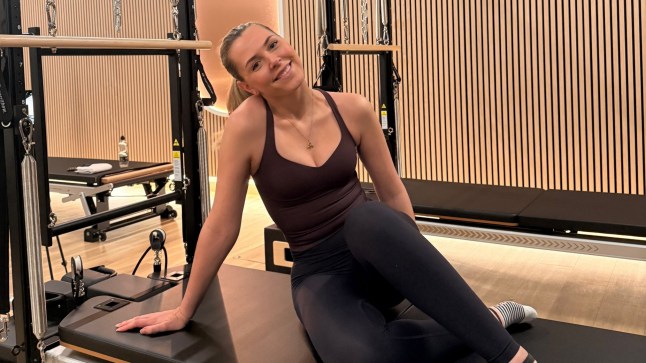
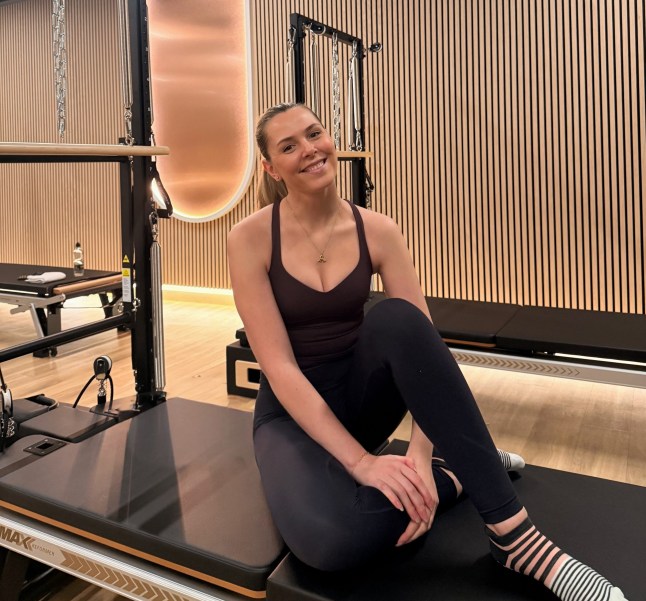
I stumble nervously into the immaculate lightwood and pleather studio, hoping my Tala leggings hide the fact that I’m a complete Pilates novice.
I’m not here to join the cult of Reformer, of which its social media domination ought to be studied.
Instead, I’m here to try its up-and-coming sister workout: Tower Pilates.
My instructor, Lydia Melmeth, at Virgin Active’s flagship Chiswick Riverside gym, patrols the class, and warns us Tower is ‘tougher’ and ‘harder’ than Reformer, but that she’ll ease us in gently.
At first glance, the apparatus looks like something you’d find in a red room, with chains and heavy metal springs hanging from various black bars. It’s rather intimidating.
In the battle of Reformer versus Tower Pilates, there’s one crucial difference. The former works on a moving ‘carriage’ or mat, that slides back and forth, with you having to engage your muscles to fight the pull of the mat.
Tower, on the other hand, has a fixed mat which doesn’t move, and instead the springs are vertical behind you on the apparatus, meaning you have to engage your muscles to pull against the springs and bring them down.
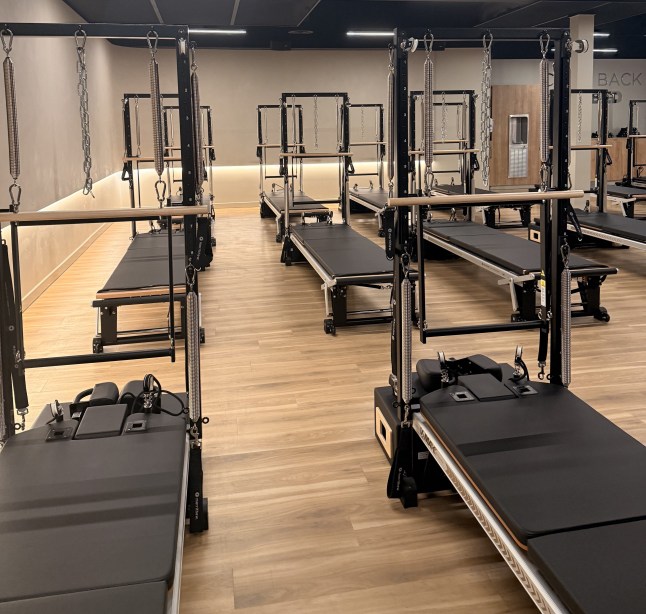
‘This can make the resistance feel heavier and more direct,’ Lydia tells Metro. ‘Because each spring works independently, the Tower provides clearer feedback on imbalances in the body.
‘It can feel more precise and controlled, highlighting asymmetries and demanding strong alignment.’
Both originated at the same time, gaining traction through the 2000s, but while Reformer took off, Tower stayed relatively in the background.
The 50-minute class saw me pulling metal springs with my core and leg muscles, before curling up my spine and supporting my body weight on nothing but my shoulders.
My shoulders now ache from holding taught metal springs while doing sit ups and my thighs burn from holding a resistance bar down while squatting and pulsing on my tiptoes.
But while my muscles burned, deeply, it was also a surprisingly zen experience. No nightclub music thumped, no Barry’s-esque instructor shouted as if it was military training, and best of all, no-one judged my beginner status.
It came as a surprise to me, given I’d only been drip-fed the Alo-wearing, expert-level, sweat-dripping, stereotype of Pilates, where instructors have been slammed for singling out less-capable students, many instances of which have gone viral on TikTok.
A decade ago, Pilates was something women of all ages would practice in village halls across the country. But the boom of Reformer – where classes often cost upwards of £25 per hour – seems to have attracted a uniform clientele: slim white women with washboard abs in matching sets.
Despite fitting (some) of these categories, it’s this miguided sense of exclusivity that has, until now, put me off modern Pilates. I have no desire to be in a space where other people don’t feel welcome.
‘The industry absolutely has room to grow when it comes to inclusivity,’ Lydia explains. ‘The practice itself is inclusive, it can be adapted for everybody and practiced by people of all ages, backgrounds, and abilities.
‘However, the rise of Instagram culture has shifted the focus toward how Pilates looks rather than how it feels. This makes some people feel as though they don’t “fit” the image of who Pilates is for.’
PT Nancy Best, founder of the Ladies Who Crunch app, agrees this is a major barrier. ‘My mum is 65 and does online classes in her bedroom because she feels “too old” for London studios,’ she tells Metro.
‘The explosion of the “Pilates girl” aesthetic is so unhelpful, not to mention aesthetic results are never a guarantee. There’s a unique interplay of factors including genetics, nutrition and recovery, so women should be cautious of any coach who promises very specific adaptations.’
That being said, in my class there was a whole spectrum of women, and even two guys, who took part. I can’t help but feel like Tower being the lesser-known, less-established sister to Reformer made people feel less daunted by the prospect of entering the Pilates world.
But, while it was an incredible experience Virgin Active, the sad reality is I won’t be able to afford to return. With a £299 a month membership (not to mention a £125 joining fee) it’s not in the budget.
Of course, the facilities are fantastic, with fresh fluffy white towels, a heated pool, sauna, massage beds, indoor and outdoor squash and tennis courts, and a spacious and quiet gym (even at peak time). One girl even gave it high praise of ‘better than Third Space’.
Nancy says even the cost of attending a class at a boutique Pilates studio is a ‘huge barrier’ for participation, not just big gyms. ‘Whilst I appreciate studios have high overheads, it’s become a status symbol that most women can’t afford on a regular basis,’ she adds.
So while I’ve had my first taste of Tower Pilates, and loved it, I’m left wondering if I’ll ever be able to foot the cost of being a Pilates girl.
Do you have a story to share?
Get in touch by emailing MetroLifestyleTeam@Metro.co.uk.