
Beloved actor, Eric Dane, best known for his role as Dr Mark Sloan on Grey’s Anatomy, has died at the age of 53.
The news comes less than a year after the father-of-two first announced his diagnosis with amyotrophic lateral sclerosis (ALS), which is the most common form of motor neurone disease.
Dane revealed his condition in April 2025, telling People: ‘I have been diagnosed with ALS. I am grateful to have my loving family by my side as we navigate this next chapter.’
In his final public appearance in December 2025, during a virtual panel, he revealed that living with the disease was ‘horrible’ and he had ‘no reason to be in a good spirit at any time’. However, he claimed he was still managing to have a ‘buoyant spirit’.
His death on February 19 was confirmed in a statement shared by his family, which read: ‘With heavy hearts, we share that Eric Dane passed on Thursday afternoon following a courageous battle with ALS.’
They added that in his final days, the actor was surrounded by ‘dear friends, his devoted wife, and his two beautiful daughters, Billie and Georgia, who were the center of his world’.

What is ALS?
ALS, sometimes also known as Lou Gehrig’s disease, is a form of motor neurone disease (MND).
MND is an umbrella term for several life-shortening, incurable conditions, which all cause motor neurones to degenerate prematurely.
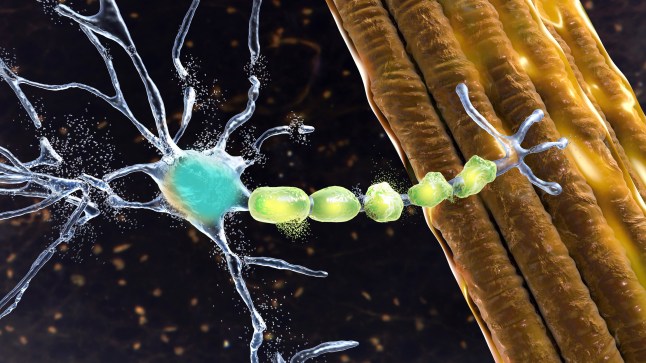
Motor neurones (also known as neurons) are nerve cells that transmit messages between the brain, spinal cord and muscles to control movement and breathing.
A disease such as ALS causes motor neurones to degenerate and die, which in turn weakens and shrinks muscles, a process known as atrophy.
As this happens, the brain becomes unable to send messages to the muscles. This means that over time, a person’s control over voluntary movements, such as walking, eating, talking, and even breathing, is lost.
There’s no single test which diagnoses ALS or MND; those with symptoms are assessed by a neurologist and undergo various tests to rule out other potential causes. This process could include blood tests, clinical examinations, an EMG, an MRI, a nerve conduction test, or Transcranial Magnetic Stimulation (TMS), which measures the activity of the upper motor neurones.
The MND Association says that MND is ‘not common’, affecting up to 5,000 adults in the UK at any one time, with a one in 300 risk of getting it across a lifetime.
For those who do have it, the average life expectancy is usually between two and five years from the onset of symptoms. However, there are exceptions to this, most notably the physicist Stephen Hawking, who lived for more than 50 years after he was diagnosed with a form of MND at 21. He died in 2018, aged 76.
What are the symptoms of ALS?
The NHS lists early symptoms of motor neurone diseases like ALS as:
- Stiff or weak hands – you may have problems holding or gripping things
- Weak legs and feet – you may find climbing stairs difficult, you may trip over a lot, and you may find it hard to lift or move your foot (foot drop)
- Twitches, spasms or muscle cramps (where muscles painfully tighten)
As the disease is progressive, it worsens over time, and other symptoms may develop, including:
- Problems swallowing, speaking and breathing
- Produce a lot of saliva (drool)
- Changes in mood and personality
- Be unable to walk or move
They add: ‘The symptoms affect everyone differently. You may not get all the symptoms, and how quickly they get worse can vary from person to person.’
Is ALS becoming more common in younger people?
According to the NHS, adults of any age can be diagnosed with motor neurone disease, but it’s more common in men and traditionally seen in those over the age of 50.
While it is rare, the disease can impact people in their 20s and 30s. On social media, a young woman called Brooke Elby has been documenting her life with ALS since being diagnosed at 29.
In one TikTok clip, Brooke, who posts under the name @limpbroozkit revealed that her first symptom was ‘drop foot’.
In a more recent update, she tragically revealed her symptoms had progressed, and she was now struggling to swallow, experiencing extra saliva, and her speech was becoming disrupted.
There is also a very rare and aggressive form of ALS, known as FUS-ALS, which develops in young people under the age of 25.
The youngest person ever thought to have been living with FUS-ALS is Kyle Sieniawski, from Pontypridd in Wales, who was diagnosed at the age of just 13 after losing mobility in his arm.
Kyle sadly died in November 2025, less than a year after being diagnosed.
Despite this, there’s currently no definitive scientific evidence that ALS is becoming more common in younger people, and the average age of diagnosis remains 60.
Why do people get ALS?
According to the NHS, ‘it’s not clear’ what causes ALS, but for most people it’s thought to be a combination of certain genes and various other factors.
Around one in 10 people with MND have a family history of the condition, but if someone in your family does have MND, it doesn’t necessarily mean you will also get it.
Do you have a story to share?
Get in touch by emailing MetroLifestyleTeam@Metro.co.uk.