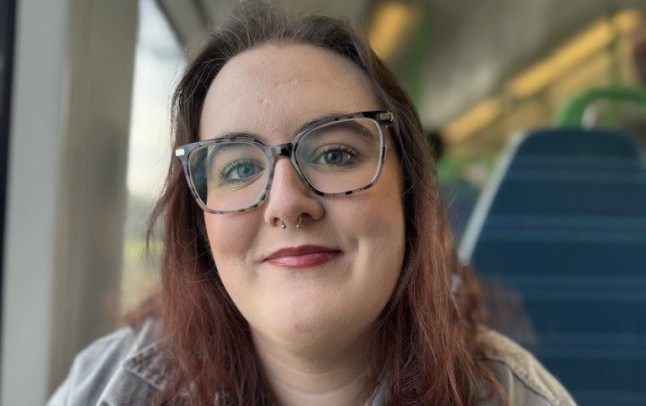
‘This isn’t what girls are supposed to look like.’
That was what I told myself, every single morning, when I looked in the mirror.
I’d then spend the next 10-15 minutes tugging at my skin, tweezing, covering and concealing the faint dark hairs that would shadow my chin.
I would tilt my head to the mirror, desperate to find an angle where I looked softer, prettier, more like the women I saw online or in magazines.
But that effortless version of femininity I thought I was supposed to represent, always eluded me.
When I was 18, following numerous scans and blood tests I was diagnosed with Polycystic Ovary Syndrome (PCOS) – a chronic hormonal condition that affects 1 in 8 women in the UK.
To view this video please enable JavaScript, and consider upgrading to a web
browser that
supports HTML5
video
My symptoms finally had a name, but that didn’t make living with them easier.
The fine hairs on my chin, bloating, acne scars and the constant fatigue, all chipped away at me. It took away the version of womanhood I thought I was supposed to embody.
Society told me to look a certain way, and knowing I had PCOS didn’t make it any easier to realise that I failed to meet that impossible standard.
A diagnosis didn’t mean people now saw my struggles with oily hair, the clumps that fell out, or the fact I sought out out every supplement I could. I was still alone.
From the moment I started puberty, I struggled with the changes my body went through.
My skin was constantly breaking out, particularly along my jawline, and each day brought another dark chin hair.
Then came the fatigue. I’d wake up already exhausted, drag myself through the day in a fog. I would later collapse into bed feeling guilty for not being more productive, more energetic, more together.
All the while, I was fighting a constant battle with heavy periods, unexplained weight gain and excess body hair.
I felt lazy, broken, and unreliable
Quote Quote
Frustratingly, I seemed to be the only one I knew that was dealing with PCOS or puberty struggles. So I was often met with insensitive comments.
I’ve had people make jokes about my facial hair, or tell me to ‘just lose weight’ – as if that would magically cure everything. I felt low, insecure and wanted to hide away.
It was as if I had become just someone to poke fun at.
I adapted my skincare based on the seasons, I tried using cleaner products and cleansing my skin better – anything to look as ‘feminine’ as possible. But nothing seemed to work.
I would still receive the same comments ‘Oh, you’ve put on weight,’ or ‘You look bloated’.
Even wearing loose-fitting jumpers and leggings, in an attempt to mask my stomach, couldn’t stop the cutting remarks.
But then, I started following women online with PCOS. They showed their facial hair proudly, spoke openly about weight fluctuations, hormonal acne, and highlighted the brutal exhaustion.
I realised that everyone’s PCOS journey isn’t the same.
One creator in particular, posted unfiltered photos of her ‘PCOS skin’ and shared honestly about struggling with her skin, changed something in me.
I thought she looked radiant, not because she was conventionally flawless, but because she was unapologetically herself.
Seeing people online reclaim their bodies helped me start to feel comfortable in mine too. I stopped seeing my symptoms as shameful, and started seeing them as proof that my body was just doing its best.
I became proud of who I was, not ashamed of who I wasn’t.
Polycystic ovary syndrome
PCOS is a common condition that affects how ovaries work. Symptoms of PCOS can include:
- irregular periods or no periods at all
- difficulty getting pregnant as a result of irregular ovulation or no ovulation
- excessive hair growth (hirsutism) – usually on the face, chest, back or buttocks
- weight gain, thinning hair and hair loss from the head, oily skin or acne
- For more information and guidance visit: https://www.nhs.uk/conditions/polycystic-ovary-syndrome-pcos/
I’m learning to see the beauty beyond my facial hair, oily skin and everything in between. I’ve learnt to just be kinder to myself especially on the flare up days.
Sadly, PCOS is still misunderstood. It is more than just weight gain or missed periods. I still feel unseen in my struggles, such as the fatigue that makes climbing a flight of stairs feel like a marathon
It puts a huge emotional toll as it affects nearly every part of my physical and mental wellbeing.
But my self-confidence has made strides. Now I know femininity means different things, embracing our flaws and not comparing ourselves to an AI version or heavily filtered picture.
Because that’s not reality.
When I look in the mirror now, I still see the same hairs, the same scars, the same dark circles under my eyes. But I no longer flinch or feel the urge to prod myself into invisibility.
Instead, I see someone who has learned that femininity isn’t fragile or universal. It’s messy, hormonal, imperfect, tired, and real.
Finally, at 30, I have learned that my body never needed fixing.
Rather the idealised image of femininity needed to evolve.
I just wish I had been able to realise that sooner.
Do you have a story you’d like to share? Get in touch by emailing M.Navarrogriffiths@metro.co.uk.
Share your views in the comments below.